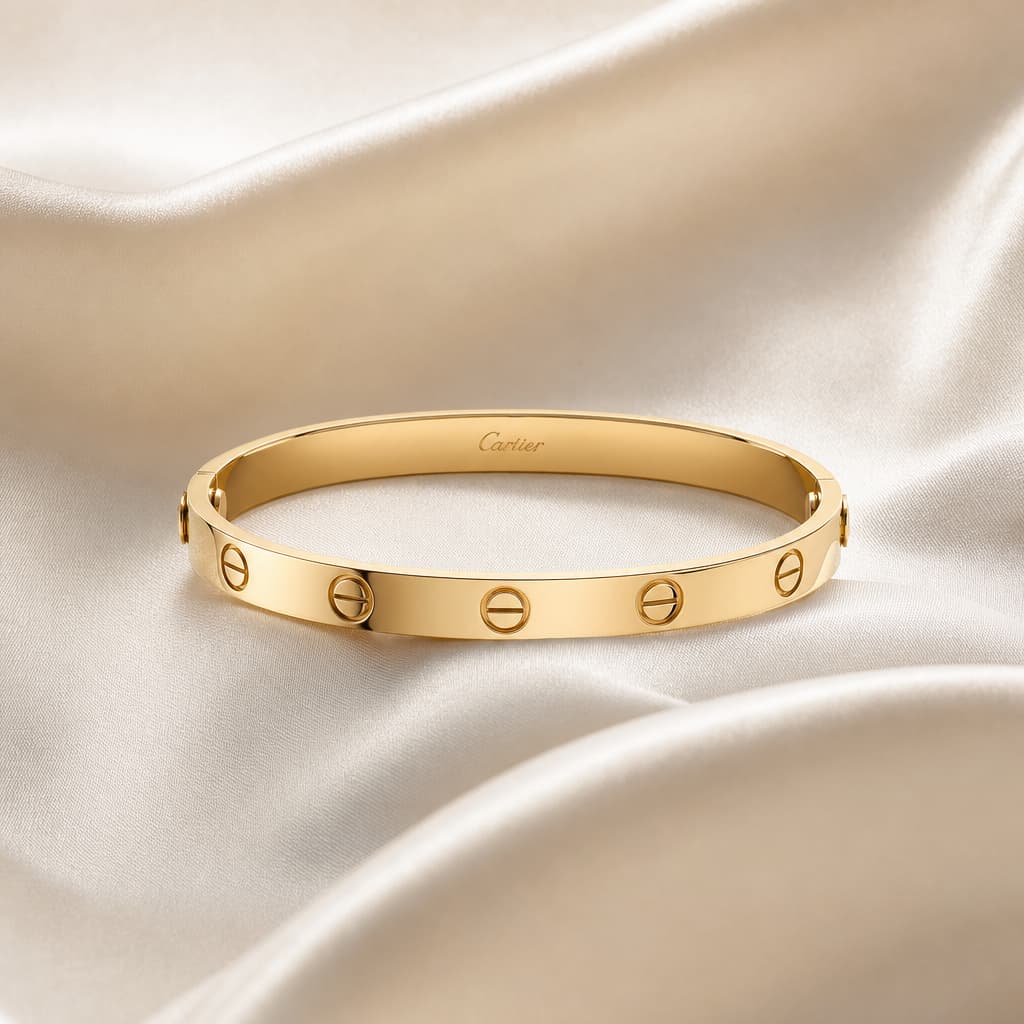
Cartier
- Panthère
- €3,200 – €26,000
- Love
- €2,900 – €11,000
- Juste un Clou
- €2,400 – €9,500
- Santos
- €900 – €6,500
- Trinity
- €700 – €4,800
Selling luxury jewellery
Sell your signed jewellery at the highest price, for more than the weight of its gold. Free insured shipping, and a bank transfer within 48 hours of your agreement.
At Ecrila. We buy your signed jewellery at the highest price, for its brand and not the weight of its gold: 10 to 18% more than the competition in our tests. Your parcel is insured up to €100,000, and the bank transfer goes out within 48 hours of your agreement.
| Price paid | 10 to 18% more than competitors in our tests |
|---|---|
| Commission | 0%: you receive 100% of the offer |
| Parcel insurance | Up to €100,000 |
| Shipping | Fast and secure, free prepaid label |
| Payment | SEPA bank transfer within 48 hours of agreement |
| If you decline | Free insured return |
| Area | All of Europe, entirely remote |
Free valuation
How it works
Selling your luxury jewellery outright means selling it directly to a professional, with no listing and no buyer to wait for. You can sell your jewellery entirely remotely, with insured shipping.
Brand, model, condition and 3 photos. The form takes about a minute, and it is free with no obligation.
An expert reviews your request and sends you an offer, with the reasons behind it: model, stones and market.
You receive a prepaid insured shipping label. Your piece stays insured up to €100,000, in transit and until the appraisal is complete.
Our gemmologists authenticate the piece in hand and confirm the firm offer. If you accept, we send a SEPA transfer within 48 hours. If you decline, it comes back to you free of charge.
Read more about how a sale works and our appraisal.
What sets us apart
A cash for gold shop pays mainly for the metal, by the gram. It suits unsigned or broken jewellery, but is far less suited to a piece from a major house.
18-carat gold contains 75% pure gold: by weight, only that share is paid for, at the day’s gold price.
Signed jewellery draws its value from the house, the model, the stones and demand on the pre-owned market. Before you sell it by weight, have it appraised.
The brands we buy
Here are our indicative price ranges for the most sought-after lines. Looking to sell a Cartier bracelet or ring? Each brand page details the models and what moves the market value.
Illustrative ranges, excluding high jewellery and collector’s pieces. The exact price depends on the model, metal, stones and condition, and is set after a hands-on appraisal. Bvlgari, Tiffany & Co. or another brand? Choose it in the form.
What your jewellery is worth
Appraising and buying jewellery go hand in hand: we weigh six criteria against the pre-owned market, and every offer comes with the reasons behind it.
This comes first. We buy a Love bracelet for €2,900 to €11,000 and a Trinity piece for €700 to €4,800. Iconic lines resell best.
Yellow, rose or white gold: purity and weight count, but on signed jewellery they do not set the whole price.
Diamonds, mother-of-pearl, onyx or malachite: their quality and condition affect the market value. A damaged or replaced stone brings it down.
At Cartier, a full set can be worth 10 to 15% more. At Van Cleef & Arpels, the certificate can add 5 to 10% to the market value.
It makes authentication easier. If it is missing, we can still buy the piece: we then rely on the hallmarks, the weight and the stones.
A discreet engraving inside a Love bracelet or Trinity ring has a limited effect, generally 3 to 8%. A visible engraving has a bigger effect.
The pre-owned jewellery market
Before you sell your jewellery, it helps to know a few things. Here is how to assess a piece, what difference the gold price makes and what to avoid before you sell.
First look for a signature: the name of the house is often inside the band, near the clasp or on the back of the piece. Then look for the serial number and hallmarks. These clues show whether the value lies in a major house or mainly in the metal.
An old receipt does not give you today’s value, and neither does an insurance valuation. The resale price depends on the pre-owned market. Only a hands-on examination can set a firm offer.
Most jewellery resells below its retail price, because that price includes the design and the jeweller’s margin. Iconic lines from the major houses hold up better: they stay well known, worn and in demand.
A rise in retail prices can support the pre-owned market. But no rise is guaranteed, and jewellery is above all something you wear.
It counts, but it is not everything. For unsigned jewellery, the gold price makes up most of the value. For a piece from a major house, the model, condition and demand matter more.
A high gold price is therefore not reason enough to sell a signed piece by weight. Have it appraised first.
On a piece from a major house, the stones are assessed with the piece, not separately. Their quality, condition and setting all count. Mother-of-pearl, onyx or malachite can wear or crack, and this affects the market value.
Never have a stone removed from its setting before the sale. If you have a gemmological certificate, include it: it helps the expert, but it is not required.
By weight, silver brings in little. Unsigned silver jewellery therefore rarely sells for much.
A signature changes things. A silver piece from a major house, such as Hermès or Tiffany & Co., can still be in demand on the pre-owned market. Submit it with your photos and we will tell you whether it meets our criteria.
Many jewellers buy by weight or offer part exchange against a new purchase. That is handy for unsigned jewellery.
For a piece from a major house, ask whether the signature counts in the offer. If it does not, you are selling a sought-after model at the price of its metal.
The price of a piece in a shop window or on a pre-owned site is an asking price, not a sold price. It includes the seller’s margin or commission.
An offer to buy outright is a net amount, paid without waiting for a buyer. It reflects what the professional takes on afterwards: appraisal, any restoration, stock and resale. To compare, look at what you will actually receive.
No. Polishing, resizing or harsh cleaning can wear down a hallmark, mark a setting or damage a stone.
Leave the piece as it is and tell us what you know of its history: repairs, resizing, a replaced stone. The offer takes this into account.
Not sure about a term? See our glossary.
Outright purchase, cash for gold, consignment or auction
For a signed piece, our outright purchase pays the highest price. You avoid selling it for the weight of its metal alone, and you do not have to wait for a buyer.
| Outright purchase | Cash for gold shop | Consignment | Auction | |
|---|---|---|---|---|
| What you are paid for | The house, the model, the stones | Mainly the weight of the gold | The piece, at its selling price | The piece, at the hammer price |
| Timing | Bank transfer within 48 hours of your agreement | Often the same day | Varies, sometimes months | Depends on the sale calendar |
| Fees | No commission | Included in the price per gram | Often 15 to 40% | Seller’s fees |
| What you do | One form and a prepaid shipment | Go to the shop | Drop off the piece, then wait | Hand the piece to the auction house |
| Best for | Signed jewellery and valuable pieces | Unsigned gold, broken jewellery | A sought-after piece, if you can wait | A rare or collector’s piece |
Our guides: where to sell luxury goods and avoid scams and selling outright or on consignment.
Selling remotely
Selling jewellery online often worries people, and that is understandable. Here is what protects you at every step.
Your piece travels by insured shipping, at our expense, and stays insured up to €100,000 until the appraisal is complete.
We pay by SEPA transfer in your name, not in notes and coins. You keep a clear record of the transaction.
Until you have accepted the firm offer, nothing is binding. If you decline, the piece comes back to you free of charge.
Authentication
Photos help us prepare the offer. Authenticity is another matter: it can only be verified with the piece in hand, under a loupe, point by point.
House name, serial number, workshop mark: their style and position must match the model and its period.
The fineness mark and the maker’s mark are read under a loupe. A hallmark that is inconsistent or poorly struck calls for closer checks.
We check its fineness and weight. In France, where Ecrila is based, 18-carat gold carries the eagle’s head hallmark.
Finishing, symmetry, clasp, how the stones are held: the workmanship must be up to the standard of the house.
We examine their cut, clarity and colour, and whether they fit the period. A replaced stone shows up at this stage.
Box, receipt, house certificate or gemmological certificate: they add to the examination, but never replace it.
Find out more about our appraisal method.
Whatever their history
An old signed piece can remain highly sought after. Do not have it cleaned or altered: let our gemmologists examine it as it is.
We take new and worn pieces alike. Condition affects the price, not whether we accept the piece: light signs of wear do not rule it out.
No box or receipt? That is not an obstacle. Tell us what you know about the piece, and the appraisal will do the rest.
A snapped clasp, a missing stone, an open link: describe the flaw and keep every part. We still consider a piece from a major house that needs repair.
A signature can be worn or hidden. Send your photos without taking anything apart: our gemmologists will look for it with the piece in hand.
High jewellery and collector’s pieces fall outside our ranges. We assess them one at a time.
Have a ring to sell? Read our guide to selling an engagement ring.
Before you send it
It only takes a few minutes. These six points help the expert assess your piece from the first offer, and they avoid surprises at the appraisal.
Look inside the band, at the clasp or on the back of the piece. Note the house and model if you know them.
The whole piece, the signature or hallmark, then the clasp or back. Show every flaw too, in daylight.
Box, certificate, receipt, removed links. None of it is required, but it all helps: include it in the parcel.
No polishing, no resizing and no cleaning at a jeweller’s before the appraisal. A soft cloth is enough.
Use a pouch or its own box for each piece so that nothing rubs, then wedge them firmly in a sturdy box.
Valid ID and proof of a bank account in your name. Ecrila is a French company, and French rules on buying valuables require us to ask for them.
Further reading
Frequently asked questions
Another question? See our FAQ or write to us.
Signed jewellery sells better to a buyer who can value the house and the model, not just the gold. You can choose an outright purchase by a buyer such as Ecrila, consignment or an auction, depending on how long you are prepared to wait.
An old signed piece should go to a buyer who understands the house and the period, or to an auction house if it is rare. Do not sell it by weight without an appraisal. Ecrila considers old pieces from the major houses remotely: just send us a request.
Look for the signature, the serial number and the hallmarks, then send 3 photos. An expert will get back to you with an offer, free of charge and with no obligation. The firm offer is set once we have examined the piece itself.
Mainly Cartier and Van Cleef & Arpels, as well as Bvlgari, Tiffany & Co. and the other major houses. Brand not on the list? Choose ‘Other brand’ in the form and describe the piece.
Yes, in most cases. The diamond, the mount and above all the signature can take its value well beyond that of the metal. That is why signed jewellery deserves an appraisal, not just a weighing.
You need to check the hallmarks, the serial number, the quality of the stones and whether the mount meets the brand’s standards. At Ecrila, our gemmologists examine every piece in hand before making a firm offer.
Yes, even without a receipt. These items add value to the piece and speed up authentication, but they are not required. A hands-on examination is enough to make an offer.
No, definitely not. On signed jewellery, the stones are assessed with the piece. Removing them damages the mount and reduces the value.
We can look at it. Describe the flaw, keep every part and do not start any repairs before the appraisal. The cost of repair is factored into the offer.
Our appraisal focuses first on signed jewellery and pieces from the major houses. For anything else, submit the piece with your photos and we will tell you whether it meets our criteria.
No, we do not buy costume jewellery. If your piece carries the signature of a major house, submit it with your photos and we will tell you whether it meets our criteria.
It changes every day with the gold price and depends on the fineness: 18-carat gold contains 75% pure gold. Our offer is not calculated by the gram. It is based on the house, the model, the stones and the condition of the signed piece.
For unsigned jewellery, compare several cash for gold shops. Ask for the fineness, weight and price per gram in writing, and have the piece weighed in front of you. If it is signed, have it appraised before you sell it by weight.
By weight, silver brings in little. A silver piece signed by a major house, however, can still be in demand on the pre-owned market. Submit it with your photos and we will tell you whether it meets our criteria.
Mainly jewellers and stone dealers, ideally with a certificate. Our appraisal focuses on signed jewellery: a stone set in a piece from a major house is assessed with the piece.
A little. A discreet engraving on the inside has a limited effect, generally 3 to 8% depending on the model. A visible or deep engraving reduces the market value further.
After we receive the piece, authentication and the firm offer follow within one to two working days. Once you accept the offer, the SEPA transfer goes out within 48 hours.
Yes. Ecrila pays only by SEPA transfer, within 48 hours of your agreement, never in notes and coins. In France, where Ecrila is based, a business cannot pay more than €1,000 that way in any case.
None. The valuation, insured shipping, authentication and any return are all at our expense. The price we offer is net.
Ecrila is a French company, and French rules on buying valuables require an identity check. We ask for valid ID and proof of a bank account in the payee’s name.
No. Everything is done remotely, with no appointment. You can sell your jewellery from anywhere in Europe using our insured shipping.
Sell your designer jewellery
A few details and 3 photos are all it takes. It is free, with no obligation.
Value my jewelleryUpdated 5 November 2026
Guides & advice