Birkin25 · 30 · 35
The ultimate grail. Togo and Epsom leathers are in high demand; exotics hold the very top of the range.
€9,000 – €45,000Indicative buyback range
We buy back at the best market price.
We track real sales across Europe to offer you the highest price we can stand behind — firmly, and with no commission.
A firm buyback offer, cash within 48 hours. Free, no obligation — insured shipping and authentication by our in-house experts.
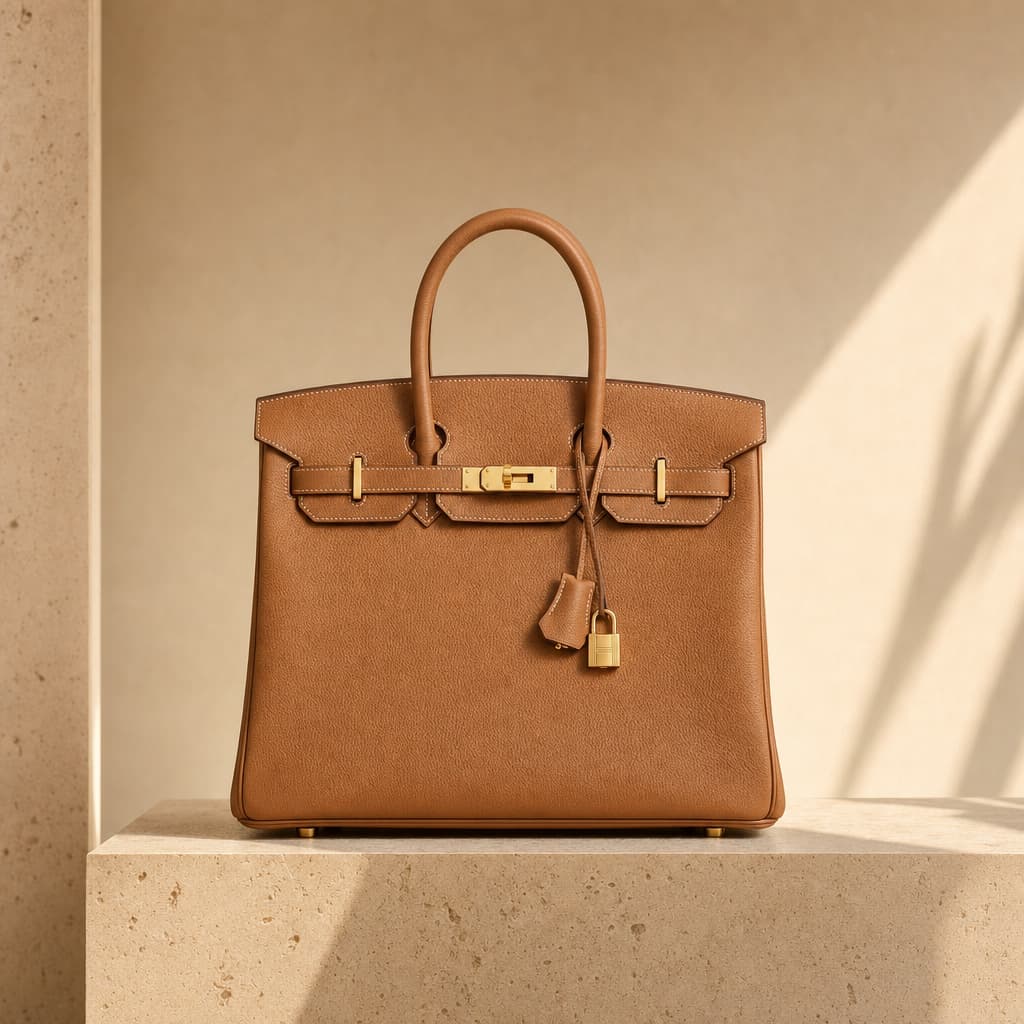
An indicative range to place your bag. The firm offer is set after appraisal — never from a photo alone.
The ultimate grail. Togo and Epsom leathers are in high demand; exotics hold the very top of the range.
In a 25 or 28, the most coveted silhouette after the Birkin. Demand stays remarkably steady.
The signature H clasp. Vivid colourways and box calf command the strongest buyback brackets.
Discreet and endlessly wearable. Supple Clemence is liquid leather — quick and easy to resell.
The everyday bucket. The 18 format and seasonal colours keep demand reliably warm.
The perforated H and canvas strap: a nomadic classic that finds a buyer with ease.
Resale guide
Hermes does not sell its iconic bags on an open shelf. To be offered a Birkin or a Kelly, a client must first build a purchase history with the maison — silk scarves, jewellery, ready-to-wear — before a sales associate will even broach the subject. This mechanism, commonly referred to as a “quota” or “purchase profile,” creates an engineered scarcity that goes well beyond ordinary marketing. Demand structurally exceeds supply, year after year, across every boutique in the world.
The direct consequence on the secondary market is remarkable: a Birkin in good condition routinely trades above its retail price, sometimes from the very day it leaves the boutique. Unlike most luxury goods, which depreciate the moment they are carried, a Hermes bag enters a parallel economy where limited production, escalating global demand and the brand's refusal to discount converge to create a genuine price floor. It is one of the very few consumer objects whose value can increase immediately after purchase.
The leather type is the single most influential variable. A Birkin 25 in Togo (grained, scratch-resistant, the workhorse of the range) or Epsom (fine-pressed, structured) sits in one bracket; the same model in crocodile Porosus — distinguished by its symmetrical, square scales and sourced from Australia or South-East Asia — can command three to five times more. Ostrich, with its distinctive quill-dot texture, typically doubles the standard valuation, while lizard, used mostly on compact formats, carries a premium of two to three times.
Colour matters almost as much. Neutral tones — black, etoupe, gold, etain — are the most liquid because they appeal to the widest buyer pool. Yet rare colourways in exotic leathers (Bleu Brighton, Rose Scheherazade, Vert Cypress) can reach auction records precisely because supply is vanishingly thin. Hardware finish adds another layer: palladium (PHW) offers a cool, tarnish-resistant sheen and is the most common pairing with neutral bags; gold hardware (GHW) brings a warmer, classic tone and often commands a slight premium on the secondary market; rose gold (RGHW), introduced more recently, benefits from scarcity. Finally, size and stamp year interact with all of the above — a Kelly 25 Sellier from a recent production year will outperform a Kelly 35 Retourne from 2008, all else being equal.
In the Hermes resale market, completeness is currency. A “full set” means the original orange box (with the correct size label), the branded dust bag, the padlock and its two keys housed in a leather clochette, the rain cover, the care booklet and — most valuable of all — the original purchase receipt. The receipt confirms provenance, boutique of origin and purchase date, which allows precise cross-referencing with the blind stamp. Collectors and resellers treat a receipted bag with noticeably more confidence, and this translates directly into a higher offer.
Even individual accessories carry weight. A missing clochette or a replaced padlock signals that the bag may have been repaired or partially restored, which invites closer scrutiny. Conversely, a bag with every original component intact — especially if the hardware shows minimal wear — signals careful ownership and can push the buyback offer meaningfully above a comparable piece sold “bare.” Our advice is simple: keep everything the bag came with, stored together, even if you never use the rain cover.
The Hermes secondary market is less seasonal than most luxury segments, but timing still matters. Demand peaks in the run-up to the autumn-winter gifting season (September through December) and again in early spring, when new collections renew interest in classic silhouettes. Summer tends to be softer, though crossbody models like the Evelyne and compact formats like the Picotin 18 hold steady year-round thanks to their travel-friendly profiles.
Beyond calendar effects, broader market signals are worth watching. When Hermes raises retail prices — which it does regularly, typically once or twice a year — the secondary market adjusts upward with a slight lag. Selling shortly after an announced price increase can capture the uplift before the market fully absorbs it. Conversely, holding a bag through a period of retail stagnation rarely costs much, because the structural scarcity described above places a firm floor under values. The general rule: sell when your bag is in the best condition you are willing to maintain, rather than waiting for a theoretical peak that may never arrive.
Two broad channels exist for selling a Hermes bag. Consignment platforms list the bag on your behalf, take a commission (typically 15 to 30 percent of the sale price) and pay you only once a buyer is found — a process that can take weeks or months, with no guarantee of timing or final price. You remain the owner until the sale closes, bearing the risk of price drops, listing fatigue and the possibility that the bag is returned unsold after the consignment window expires.
Direct buyback, the model we operate, works differently. We examine the bag, quote a firm offer and pay cash within 48 hours of acceptance. There is no commission, no listing period and no uncertainty: the price you are quoted is the price you receive. The trade-off is that the buyback price may sit below the highest possible retail resale price, because we absorb the risk of resale timing and market fluctuation. For sellers who value speed, certainty and zero fees over the possibility of a marginally higher but uncertain payout, direct buyback is the more practical path. We process thousands of Hermes bags every year, and the overwhelming feedback is that the certainty of a firm offer, paid quickly, outweighs the speculative upside of a consignment listing.
Every Hermes bag carries two discreet markings that together form its birth certificate. The blind stamp — a heat-pressed letter found under the front flap (Birkin) or inside the rear pocket (Kelly) — encodes the year of manufacture. From 1945 to 2014, the alphabet was cycled with framing symbols (circle, square, no frame) to distinguish eras. Since 2015, the system restarted at T with no frame, then introduced a dash above the letter from 2016 onward. Alongside it sits the craftsman stamp: a small geometric glyph — a diamond, a horseshoe, a star — unique to the individual saddler who hand-stitched the bag from start to finish. This mark means your bag can, in principle, be traced back to the single artisan who created it.
During our appraisal, we cross-reference both stamps with the leather type, hardware generation, stitching style and model specifications to confirm authenticity and establish a precise date. This level of traceability is unmatched in the luxury world and is one of the reasons Hermes bags command such enduring trust on the resale market.
Buying back a Hermes bag carries a responsibility. Here is ours, in four promises kept.
No consignment, no hidden commission: we buy your bag outright and quote a net price that is firm and fully explained.
Leather, saddle stitching, stamp, blind stamp and hardware: every bag passes through the hands of our Hermes specialists.
Once the offer is accepted, the transfer leaves within forty-eight hours. No waiting, no conditional settlement.
Quote, insured shipping and appraisal are on us. If the offer isn't for you, your bag comes straight back, free of charge.
Describe your bag in 30 seconds: model, leather, colour, completeness. You receive an instant buyback range, with no obligation.
We send you a free, fully insured shipping label. Your bag travels covered all the way to our appraisal atelier.
After authentication, we confirm the firm offer. The transfer leaves within 48 hours. Decline freely, return is free.
You receive an instant estimate online. As soon as your bag arrives at our atelier and is authenticated by our specialists, we confirm the firm offer. Once you accept, the bank transfer is released within 48 hours — typically 24 to 48 hours depending on your bank.
None whatsoever. The estimate, insured shipping, expert appraisal and any return are completely free. We buy your bag outright with a firm offer: the price quoted is the price paid, with no commission, no platform fee and no hidden deductions.
Every bag is examined in person by our Hermès specialists. We verify the craftsman stamp (a unique geometric symbol assigned to the individual saddler who hand-stitched the piece), the blind stamp (a heat-pressed letter indicating the year of manufacture, with an encoding system that restarted in 2015), the leather grain and consistency, the saddle stitching (done by hand with two needles and waxed linen thread), and every piece of hardware (engravings, weight, plating integrity). This multi-criteria expertise underpins the firm offer.
All current and discontinued models: Birkin (25, 30, 35, 40), Kelly (Sellier and Retourné, 25 to 35), Constance (18, 24), Bolide (27, 31), Lindy (26, 30), Picotin (18, 22), Evelyne (16, 29, 33), Garden Party, and Herbag. We also accept special editions, exotic leathers (crocodile, ostrich, lizard) and artist collaborations.
Yes, completeness matters. A full set — original orange box, dust bag, padlock and keys, clochette, rain cover, care booklet and purchase receipt — commands a measurably higher buyback price. The receipt in particular confirms provenance and date. That said, we buy bags without their full set every day; the offer simply reflects the items present.
Several factors converge. The leather type is decisive: a Birkin in Togo or Epsom sits in a different bracket from the same model in crocodile Porosus, which can command three to five times more. Hardware finish (palladium, gold, rose gold), size, colour rarity, stamp year and overall condition all feed into the valuation. We cross-reference current secondary-market data and auction results to ensure our offer reflects true demand.
You are under no obligation. If the firm offer does not meet your expectations after physical appraisal, simply let us know and we return your bag free of charge, fully insured, within two working days. There is no penalty, no fee and no pressure — the process is designed to be entirely risk-free for the seller.
Absolutely. Vintage Hermès pieces — including discontinued leathers, rare colourways and older production runs — are actively sought by collectors. A well-preserved vintage Kelly or Birkin with an early blind stamp can command premiums precisely because of its age and scarcity. Our specialists are trained to date and value these pieces accurately, so the offer reflects their true collector value.
Buyback — Hermes bag
A few details about your bag is all it takes. Free, no obligation, cash within 48 hours.
Get a free quote →4.8/5 · 12,400 buybacks · paid in 24-48 h · insured shipping
Also sell
Guides & advice